
E-Archive

 BACK
BACK
Off the Beaten Track
in Vol. 26 - March Issue - Year 2025
The Twisted Tale of Paper Clips
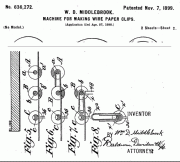
Figure 1: Patent for a paper clip machine
It is often interesting to talk about great inventions like the telephone, lightbulb, an aircraft, or high-speed trains, or in the modern context of recent scientific and technological inventions like quantum computing or 4D printing. But we seldom think about tiny things that have become an inseparable part of our daily lives, yet we have no idea who invented them or what their journey was like.
So, here’s a look at a humble device that helps hold all the paperwork in the world… including the research papers behind the above inventions too! Yes, we are honoring the paper clip: a small, unassuming twist of wire, the unsung hero of desks and junk drawers. Its journey is a story of genius, persistence, and a touch of absurdity, proving that sometimes, the simplest ideas are the hardest to pin down. Let’s pin down the “U-pin” on a lighter note!
It works on a simple principle, utilizing torsion and elasticity through the friction between the wire and paper. The “tongues” of the clip being forced apart cause torsion in the bend of the wire to grip the sheets together, binding the papers for productivity and portability without puncturing or damaging them. Its widespread use in various settings, from offices to educational institutions, underscores its functional design and adaptability. While primarily designed for binding papers, its versatility has led to a range of applications, both practical and creative.
The invention of paper in China around 100 CE set the stage for the paper clip’s eventual arrival. Mankind had no idea they were going to face the real problem: keeping their paperwork in order. Then came the Industrial Revolution, when humanity collectively realized that paperwork was here to stay, and that it was multiplying faster than rabbits in spring.
Before the advent of the paper clip came perhaps the prehistoric age of paper chaos, where papers were left to roam wild and free—or, more accurately, to become lost, crumpled, tied together with ribbons, or crushed under paperweights.
The paper clip, as we know it, was born in the late 19th century. Different claims exist pertaining to the real inventor. According to the Early Office Museum, the first patent for a bent-wire paper clip was awarded in the U.S. to Samuel B. Fay in 1867. It was originally intended for attaching tickets to fabric, although the patent recognized that it could be used to attach papers together. Some unsupported claims insist that English intellectual Herbert Spencer registered a "Binding-pin" in 1846. Another claim suggests that Norwegian Johan Vaaler invented a similar design and was granted a patent in the U.S. and Germany in 1901. However, Vaaler’s design wasn’t quite the paper clip we know today. His design lacked the inner loop that provides extra grip.
Meanwhile, in the United States, the Gem Manufacturing Company quietly perfected the design we now use—a double-looped marvel of physics and simplicity. Countless variations on the same theme were patented—some have pointed instead of rounded ends, some have the end of one loop bent slightly, and some have wires with undulations or barbs to get a better grip. In addition, purely aesthetic variants were also patented, including clips with triangular, star, or round shapes. But for more than a hundred years, the Gem clip has proved to be the most practical and by far the most popular, and yet it was never officially patented.
Philosophically, the paper clip is more than just an office supply; it’s a metaphor for life. Think about it: it’s flexible yet resilient, unassuming yet indispensable. It holds things together when they’d otherwise fall apart, much like a good friend or duct tape. It reminds us that greatness doesn’t always announce itself with fireworks and fanfare—sometimes, it’s quietly holding together your tax receipts.
Today, the paper clip faces stiff competition from digital tools. After all, who needs a clip when you can email PDFs or upload files to the cloud? But even in the digital age, the paper clip endures. It’s a reminder of simpler times, when office drama involved jammed staplers rather than crashed servers. It’s the underdog of office supplies, proving that you don’t need to be flashy to be indispensable. Ironically… you still click on the paper clip icon whenever you have an “attachment” to send in your email!
So, here’s to the paper clip: a small invention with a big impact. It’s twisted, it’s resilient, and it’s always there when you need it—unless it’s lost at the bottom of your desk drawer.
MFN Trainer and Head of Operations of Daksha: rishabh.shah@daksha.net