
E-Archive

 BACK
BACK
Articles
in Vol. 27 - January Issue - Year 2026
Understanding the True Cost of Shot Blasting Operations
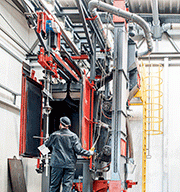
Shot blasting machine
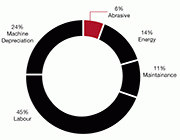
Typical blasting cost breakdown
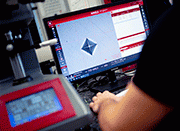
Testing abrasives
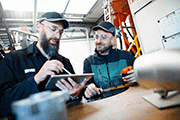
Sharing total blasting cost data
In surface preparation and finishing industries, shot blasting remains a vital operation. Whether the goal is to clean, descale, prepare, or strengthen metal surfaces, the efficiency and cost-effectiveness of the blasting process play a decisive role in overall production economics.
However, when it comes to evaluating and optimizing a blasting operation, it is still common for purchasing and production decisions to be based primarily on the cost of the abrasive material. At first glance, this seems logical — abrasive is the visible consumable, and the price per tonne is easy to compare between suppliers. Yet in reality, abrasive cost represents only a small fraction of the total expense of operating a blasting process.
A closer examination reveals that the true cost of shot blasting is distributed across several key factors, and understanding this balance is crucial for making decisions that improve both efficiency and profitability.
The Real Cost Breakdown
Comprehensive industry studies and decades of field experience show that the total cost of a typical shot blasting operation for a 4 wheel surface preparation machine can be broken down as follows:
• Labour: 45%
• Machine depreciation: 24%
• Energy: 14%
• Maintenance: 11%
• Abrasive: 6%
This breakdown highlights a crucial insight: the abrasive itself represents only around one twentieth of the total cost of running a blasting operation. The majority of expenses arise from labour, energy, and capital costs — factors that are heavily influenced by the performance of the abrasive, rather than its price.
In other words, an abrasive that allows faster cleaning, reduced wear, or lower energy consumption can have a disproportionate positive impact on total cost — even if its purchase price is slightly higher.
Beyond the Price Tag: The Performance Advantage
At Ervin, we have been conducting comparative performance testing of abrasives for decades, under controlled conditions and in partnership with customers across a wide range of applications. These tests — numbering in the hundreds — consistently show that Ervin abrasives can deliver a 30-40% performance advantage over competitor products.
This advantage is not a single metric; it manifests in several practical ways, depending on how the customer chooses to use it. The benefits can be realised as:
• Increased output: More parts processed per hour or per shift.
• Reduced energy usage: Lower power consumption per tonne of output.
• Reduced waste: Less dust generation and lower waste disposal costs.
• Reduced rework: Better, more consistent surface quality reduces the need for secondary cleaning or finishing.
• Reduced abrasive consumption: Higher durability and longer life per particle mean less abrasive is used over time.
Each blasting operation is different. Some customers operate at maximum capacity and seek higher throughput without increasing total costs. Others focus on cost control or energy efficiency. The flexibility of the performance advantage allows it to be tailored to the customer’s specific production priorities.
The Hidden Cost of Focusing on Purchase Price
It is understandable that many purchasing departments focus on the cost per tonne of abrasive, as it is an easily measurable figure. However, this approach assumes that all abrasives deliver the same level of performance — an assumption that does not hold true in practice.
Our long-term testing and customer experience demonstrate that the choice of abrasive affects not only abrasive consumption but also machine wear, energy usage, and even operator efficiency. For example, if a lower-quality abrasive fractures more quickly, it produces more dust and fine particles, which in turn increases dust extraction load, reduces visibility, and shortens the lifespan of wear parts such as blades and liners.
All of these effects contribute to higher operational costs, even if the abrasive itself appears cheaper on paper. Conversely, a more durable, consistent abrasive reduces these hidden costs and increases productivity.
Therefore, a small improvement in abrasive performance can translate into a large reduction in total cost per blasted part — an insight that becomes clear only when looking at the complete cost picture.
Ervin’s Proven Track Record
For more than a century, Ervin has been dedicated to advancing the science and performance of metallic abrasives. Our products are manufactured to exacting standards, ensuring consistent quality and repeatable performance. Over the decades, we have accumulated an extensive database of comparative test results, representing hundreds of applications across both wheel blasting and air blasting technologies.
This data has consistently confirmed the same principle: Ervin abrasives outperform competitor products, not just in laboratory testing but in real-world industrial environments. Customers report measurable improvements in productivity, reduced maintenance downtime, and lower overall blasting costs — all without compromising surface quality.
Importantly, these performance advantages allow customers to decide how they wish to capture the value:
• Maintain output while reducing total cost, or
• Increase output while keeping total cost stable.
In either scenario, the financial reward from improved performance far outweighs any small variation in abrasive price per tonne.
Data-Driven Optimization: The Ervin Total Cost of Blasting (TCB) App
Building on decades of testing and field experience, Ervin has developed a new digital tool to help quantify and visualise the true economic impact of abrasive performance: the Ervin Total Cost of Blasting (TCB) app.
The TCB app is designed for use by Ervin’s technical and sales teams during site visits, enabling them to perform rapid, data-based assessments of a customer’s blasting operation. By combining real operating data with Ervin’s extensive comparative performance database, the app can accurately estimate the expected total cost savings achievable by switching to an Ervin abrasive.
How it Works
The app brings together three major data sources:
1. Ervin’s proprietary performance data from many years of comparative testing.
2. Extensive operational knowledge of wheel and air blasting machines.
3. Independent cost data for energy, labour, and maintenance across different countries and industries.
During a site visit, the Ervin representative inputs a set of parameters to tailor the calculation to the customer’s specific conditions. These include:
• Basic information: Country, language, and currency.
• Customer data: Application type, energy cost, and labour cost.
• Machine details: Type, number and size of blast wheels, number of operators.
• Process parameters: Operating hours, output rate, full-load current, and speed improvements.
• Abrasive data: Product name, consumption rate, purchase price per tonne, durability, wear, and waste disposal cost.
The app then analyses this information, using Ervin’s database of benchmark results to predict potential performance improvements and cost savings. The outcome is a clear, quantitative estimate of the financial benefit that could be achieved by optimising the abrasive choice.
A Practical Decision Tool
The value of the TCB app lies not only in its technical sophistication but in its practicality. It allows Ervin field specialists and customers to have data-driven conversations about performance and cost, grounded in measurable parameters rather than assumptions.
For production engineers and managers under constant pressure to reduce costs and increase efficiency, this type of transparent analysis provides a powerful decision-making aid. It helps identify where small process improvements can yield significant financial results — all while maintaining or improving quality.
Seeing the Bigger Picture
The TCB app reinforces an important message: the lowest-cost abrasive is not necessarily the most economical choice. The total cost of a blasting operation depends on the complex interaction of many variables — machine efficiency, labour productivity, maintenance requirements, energy usage, and abrasive durability among them.
By understanding and optimising these interactions, manufacturers can unlock hidden value in their surface preparation processes. In most cases, this optimization starts with choosing an abrasive that performs consistently and efficiently — one that has been proven to reduce overall operating costs.
Ervin’s ongoing commitment to testing, data collection, and innovation ensures that our customers have the tools and information they need to make these informed decisions with confidence.
Conclusion: Think Beyond the Abrasive Price
When evaluating your blasting operation, consider where the real costs lie — and where the greatest opportunities for improvement exist. The abrasive may only account for around 6% of total expenditure, but its performance has a direct impact on the other 94%.
By taking a total cost perspective, and by using tools such as the Ervin Total Cost of Blasting app, it becomes possible to quantify and capture the hidden savings available through better abrasive performance.
So, before making your next purchasing decision, take a step back and look at the bigger picture. Reflect on where increased output or reduced operating costs could deliver the most benefit to your business.
And when you are ready to explore those opportunities, speak to your local Ervin representative — they have the data, tools, and expertise to help you make your blasting operation as efficient and cost-effective as possible.
For Information:
Ervin Germany GmbH
Rudower Chaussee 48
12489 Berlin, Germany
Tel. +49.30.400 37846
E-mail: info@ervin.eu
www.ervin.eu