
E-Archive

 BACK
BACK
From the World of Blasting
in Vol. 27 - January Issue - Year 2026
Shot Blast Profiles and Coating Adhesion: Why the Right Surface Preparation Matters

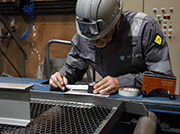
Blast Check Kit – Profile inspection
WA Clean
In protective coatings, long-term performance begins long before the first layer of paint is applied—it starts with the surface profile, specifically the micro-roughness created by shot blasting. A properly formed anchor pattern ensures mechanical adhesion, coating uniformity, and extended service life. An inadequate or inconsistent profile is one of the most common causes of premature coating failure. Understanding how profiles are generated—and how to verify them—is essential for any coating or fabrication facility focused on reliability and cost control.
Shot blasting produces a surface profile by propelling abrasive media at high velocity. Each particle impacts the substrate, plastically deforming the metal to form peaks and valleys. The height of these impressions defines the anchor profile, typically measured in mils using replica tape or stylus methods. Profiles that are too low reduce mechanical grip, while overly aggressive profiles increase coating consumption, promote peak rust-through, and may undermine long-term adhesion.
Coating manufacturers specify target profile ranges to optimize adhesion for their resin systems. High-build epoxies may require 2.0–3.5 mils, whereas zinc-rich primers generally call for shallower, more controlled textures. Achieving these profiles consistently depends on abrasive size and shape, machine operating parameters, and the condition of the operating mix.
Abrasive size has the greatest influence. Larger steel shot (e.g., S390 or S460) creates deeper impressions, while smaller media (S170 or S230) produces smoother finishes. The abrasive type—rounded shot versus angular grit—also plays an important role. Angular grit cuts sharper profiles suited for heavy-duty coatings, while rounded shot produces more uniform compressive patterns where fatigue resistance or surface integrity is critical.
However, even the correct abrasive cannot compensate for poor machine conditions. Wheel speed, abrasive throughput, targeting, and part dwell time all determine impact energy. A machine running out of spec may fail to achieve the desired profile, even when the correct media is used. Likewise, an unhealthy operating mix—whether overloaded with fines, depleted of large particles, or otherwise unbalanced—creates irregular and unpredictable profiles.
This is where Winoa’s technical tools provide measurable value.
Winoa Blast Check Kits, designed for daily use, allow operators to track abrasive sizing, operating mix balance, and separator performance. By ensuring the machine runs within controlled parameters, facilities can maintain consistent profiles and avoid the drift that leads to coating failures.
Once the surface is blasted, verifying cleanliness is equally important for adhesion. Residual contaminants—mill scale, dust, oil, or embedded debris—can act as a barrier between the coating and the substrate. WA Clean®, Winoa’s patented color-spectrometry technology, provides a quantitative cleanliness rating from 0 to 100. This removes subjectivity from visual inspection and ensures that surfaces meet the required standard before coating application. A surface that shows an acceptable profile but poor cleanliness still risks delamination, under-film corrosion, and premature coating breakdown.
Ultimately, controlling shot blast profiles requires a full-system approach: the right abrasive selection, the right machine settings, and the right verification tools. Facilities that incorporate Winoa’s Blast Check Kits and WA Clean technology into their preparation process achieve higher coating adhesion, reduced rework, and longer asset protection. Proper surface preparation remains the foundation of coating longevity—and Winoa provides the tools to get it right every time.
Contact: chris.prouty@winoa.com
Written by Chris Prouty, Contributing Editor for MFN and Technical Advisor at Winoa