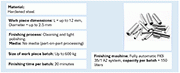
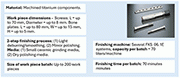
When centrifugal disk finishing was invented in the 1970s, it was initially met with some skepticism. Today, thanks to the numerous technical benefits it offers, centrifugal disk finishing has become one of the most popular mass finishing technologies for treating complete batches of very small to mid-size components. Because of their high processing intensity, centrifugal disk systems can produce finishing results up to ten times faster than vibratory equipment. However, special built-in technical features allow the processing intensity to be adjusted—from aggressive deburring and edge radiusing all the way to gentle surface smoothing and even polishing. In addition, centrifugal disk systems are very easy to automate. All this makes centrifugal disk finishing one of the most versatile finishing methods on today’s market.
A Surprisingly Effective Finishing Technology
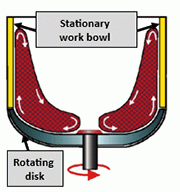
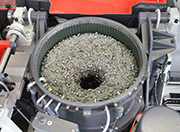
The main components of centrifugal disk finishers are a stationary cylindrical work bowl and a rotating disk running at speeds of 60–250 RPM. The centrifugal force of the rotating disk impels the mix of processing media and workpieces up the wall of the stationary work bowl. Once the media/workpiece mix has lost its kinetic energy, it collapses to the center of the disk, from where it is accelerated again.
The high speed of the media/workpiece mix creates very high pressure between the media and workpieces and, therefore, results in extraordinary processing intensity. For this reason, centrifugal disk finishing achieves the desired results—be it deburring, edge radiusing, surface smoothing, etc.—up to ten times faster than vibratory equipment.
Disk finishers are typical batch machines, i.e., one complete batch of workpieces is treated at a time. Upon completion of the finishing operation, the entire batch of media and finished workpieces is discharged onto a separation device. This ensures that batches with different workpieces never get mixed up!
Numerous Technical and Economic Benefits
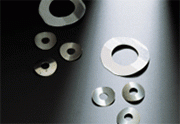
Centrifugal disk machines are exceptionally versatile. They can handle very small parts with a size of less than 15 mm and only 0.15 mm thick (!) as well as midsize components measuring up to 200 mm.
They produce outstanding surface finishes in amazingly short cycle times. Compared to vibratory equipment, and due to their high process intensity, centrifugal systems can be run with less abrasive and smaller processing media. This provides not only better media coverage on the workpiece surface but also produces a much finer finish.
However, centrifugal force machines are not only suitable for aggressive deburring and edge radiusing. They are equally effective for gentle surface smoothing. Because the speed of the rotating disk is variable, the treatment intensity can be adjusted from aggressive (high speed) to very gentle (low speed).
Moreover, since water has a cushioning effect on process intensity, injecting process water into the work bowl makes the finishing process less intense and much gentler. For this reason, with the right processing media and compound, centrifugal disk finishing can even produce high-gloss polishes!
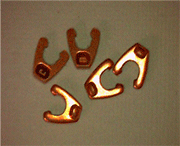
Of course, centrifugal disk systems can also be used for part-on-part finishing without any processing media. In this case, the finishing goals are achieved by the workpieces “rubbing” against each other. For example, after copper plating, die-cast aluminum zipper parts are washed and polished in centrifugal disk machines in a part-on-part finishing operation.
Last but not least, centrifugal systems can also handle workpieces covered with oil. For example, when coming from a stamping line, they will carry relatively large amounts of oil into the finishing machine. With suitable chemical compounds, the oil is completely removed from the workpieces. They leave the finishing system perfectly deburred and absolutely clean, without any traces of residual oil.
Thanks to sophisticated electronic process controls, centrifugal disk finishing produces absolutely consistent surface finishes—batch after batch.
Automation
Centrifugal disk finishing machines not only produce consistently high-quality surface finishes in amazingly short cycle times, but they can also be very easily upgraded into fully automated finishing systems, either integrated into automatic manufacturing lines or used as stand-alone finishing centers.
Special material-handling components such as automatic roller conveyors, in combination with different types of hydraulic or mechanical loaders, vibratory hoppers, special conveyor belts, etc., allow the staging and automatic processing of workpieces for several shifts without any operator involvement. Pictures 12 and 13 show a fully automated Rösler FKS 15.1 A2 centrifugal disk finishing system.
Linking all these different systems together is achieved by sophisticated electronic controls. Bar code scanners trigger the selection of the correct processing program in the system PLC. For production control purposes (just-in-time operation), the PLC can be linked to a higher-level master computer. Video cameras monitor the complete process and can trigger an alarm in case of deviations—for example, lodged media in a finished workpiece. Process functions are also automatically adjusted to changing operating conditions, such as increasing the compound dosing rate when more oil is carried into the finishing process.
Good Vibrations
by Eugen Holzknecht
Contributing Editor MFN and
Rösler Oberflächentechnik GmbH
E-mail: holzknecht.usa@gmail.com





 BACK
BACK