Introduction
Additive manufacturing (AM), particularly laser powder bed fusion (LPBF), has enabled unprecedented design freedom and the rapid production of high-performance Ti-6Al-4V components for aerospace, biomedical, and many other industrial applications. Despite these advantages, AM-processed Ti-6Al-4V parts typically exhibit rough and irregular as-built surfaces resulting from partially melted particles, balling phenomena, and staircase effects. These surface defects can significantly degrade fatigue performance, tribological behavior, corrosion resistance, and dimensional precision, ultimately limiting the use of AM components in safety-critical environments. Consequently, surface-finishing has become an essential step in AM process chains to ensure structural integrity and functional reliability.
Plasma electrolytic polishing (PEP) has emerged as a promising surface-finishing technology for complex AM geometries due to its ability to achieve micrometer-scale smoothing, environmentally benign electrolyte systems, and compatibility with intricate internal channels that are inaccessible to mechanical techniques [1]. Operating in the transpassive or microarc regime, PEP relies on rapid anodic dissolution, vapor–gas envelope (VGE) formation, and localized plasma discharges to selectively remove asperities [2]. Compared with conventional electrochemical polishing, PEP offers improved stability and higher material-removal rates, particularly for hard-to-machine alloys such as Ti-6Al-4V. However, achieving uniform and efficient polishing on AM surfaces remains challenging due to heterogeneous microtopography, spatial variations in electric-field intensity, and the complex interplay between plasma behavior and electrolyte transport.
Recent studies revealed that acoustic fields can influence PEP process through several synergistic mechanisms [3], including (i) agitation of the electrolyte to reduce concentration gradients; (ii) disruption or thinning of the vapor-gas envelope (VGE) to promote more stable discharge behavior; (iii) enhanced detachment of hydrogen bubbles and oxide debris; and (iv) modulation of plasma discharge distribution across the surface. These effects collectively contribute to more uniform material removal, improved surface quality, and potentially reduced processing times.
For AM Ti-6Al-4V, in which surface features vary significantly with build orientation, scanning strategy, and heat treatment, acoustic assistance may be particularly beneficial. The high-aspect-ratio unmelted particles and sharp asperities commonly found on upward-facing and side-facing surfaces can hinder stable VGE formation, leading to nonuniform polishing patterns. Introducing acoustic energy can mitigate these limitations by stabilizing mass transport and promoting consistent plasma micro-arcing, thereby enabling more reliable smoothing across complex geometries. Additionally, the inherent porosity and microstructural heterogeneity of AM Ti-6Al-4V may alter the local response to plasma discharges; thus, understanding how acoustic fields influence dissolution and discharge dynamics is essential for optimizing PEP conditions for such materials. A deeper understanding of acoustic wave emission and its interactions with the surface of the workpiece is needed to establish processing maps, elucidate underlying mechanisms, and guide the implementation of PEP as a robust and scalable finishing solution for next-generation AM components. This science update discusses recent observations of acoustic emissions and their associated pressure-wave effects on the surface finishing of AM Ti-6Al-4V coupons during the PEP process.
Materials and Methods
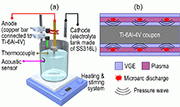
The AM Ti-6Al-4V coupons (100 mm × 10 mm × 3 mm) were vertically built using LPBF [4]. The PEP process was carried out with the setup shown in Fig. 1(a). The aqueous electrolyte, consisting of NH4F (3.53 wt.%) and KF (2.18 wt.%) with a pH value of ~6.4, was held in a stainless steel (SS316L) container. The SS316L container also served as the cathode during the PEP process. The AM Ti-6Al-4V coupon functioned as the anode and was positioned vertically at the center of the container. During processing, the voltage and current profiles were monitored by the power unit, the electrolyte temperature was measured using a K-type thermocouple, and the acoustic emissions were recorded by a sensor attached to the outer wall of the SS316L container. Fig. 1(b) presents a schematic diagram, illustrating the emission of acoustic waves within the VGE and their interactions with the coupon surfaces.
Results and Discussion
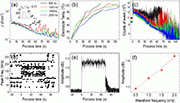
Figs. 2(a)–2(c) present the profiles of current density, electrolyte temperature, and acoustic emission counts, respectively, collected within a single cycle of the PEP process. The inset shows a typical single period of the waveform, and the excitation frequency was intentionally varied from 500 to 2000 Hz. It can be seen that the current density [Fig. 2(a)] and the acoustic emission counts [Fig. 2(c)] exhibit similar evolutions as a function of processing time. In contrast, the electrolyte temperature [Fig. 2(b)] increases monotonically throughout the process. These observations indicate a strong correlation between acoustic emissions and current density rather than electrolyte temperature.
Figs. 2(d) and 2(e) present the peak frequencies and amplitudes, respectively, of the acoustic emissions during the PEP process at a waveform frequency of 500 Hz. A summary of the acoustic amplitudes as a function of waveform frequency is plotted in Fig. 2(f). The variations in acoustic emission counts, peak frequencies, and amplitudes as a function of waveform frequency may produce different mechanical effects on the surface finishing achieved during the PEP process.
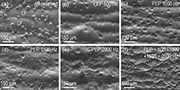
Fig. 3(a) presents a typical SEM image collected from the surface of an as-received AM Ti-6Al-4V coupon, showing the characteristic morphology of unmelted small particles (SPs) and larger features (LFs) resulting from the termination of melt pools on the coupon surface. The SEM images in Figs. 3(b)–3(e) show that the SPs were effectively removed by the PEP process. After their removal, craters appeared, and close examination revealed that they were predominantly spherical caps, as shown in Fig. 3(b). However, deformed craters were observed in Fig. 3(c), and both their number and degree of deformation increased in Figs. 3(d) and 3(e), respectively. These observations, together with the acoustic emissions reported in Figs. 2(c) and 2(f), suggest that the crater deformation originates from acoustic effects—namely, the impact of pressure waves on the surface, as illustrated in Fig. 1(b). The SEM image in Fig. 3(f), which shows the cascaded PEP process on a coupon surface sectioned by wire electrical discharge machining, further confirms the role of acoustic emissions and pressure-wave-induced plastic deformation occurring alongside plasma-enhanced electrochemical reactions during the PEP process.
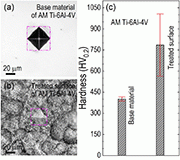
Fig. 4 presents typical hardness measurements obtained by micro-indentation for the AM Ti-6Al-4V coupon before and after the PEP process. Figs. 4(a) and 4(b) show optical micrographs of the indentations (HV0.2) on the base material and on the PEP-processed surface of the AM Ti-6Al-4V coupons, respectively. It can be seen that, after the PEP process, the indentation size became much smaller. Consequently, Fig. 4(c) shows that the surface hardness increased significantly, rising from ~400 HV0.2 to ~800 HV0.2—approximately a twofold increase.
Conclusion
The presence of acoustic emissions during the PEP process was successfully detected using a piezoelectric sensor attached to the electrolyte tank. The amplitude of the acoustic waves increased monotonically with the applied waveform frequency. At lower frequencies, the acoustic waves dislodged unmelted particles from the AM Ti-6Al-4V coupons, leaving behind spherical craters. However, increasing the waveform frequency led to the formation of deformed craters, indicating stronger surface impacts from the acoustic waves. In combination with the plasma-enhanced electrochemical reactions occurring during PEP, these effects contribute not only to surface smoothing but also to improvements in surface integrity. A cascaded PEP process increased the surface hardness of LPBF-built AM Ti-6Al-4V coupons from ~400 HV0.2 to ~800 HV0.2. These observations provide new insights into the PEP process and support further advancements toward the industrialization of AM technologies.
Acknowledgement
This work is partly supported by the Singapore Aerospace Programme (SAP Cycle 17, Grant No. M2315a0084, Project No. SC25/23-834917). The authors would also like to acknowledge Yee Ng and Xian Yi Tan for their assistance with the PEP process and data collection.
References
[1] X. Y. Tan, et al., “Plasma electrolytic polishing-induced surface chemical and structural evolutions of additively manufactured Ti-6Al-4V coupons” Surf. Coat. Technol., Vol 494, pp. 131557, 2024.
[2] Y. Ng, et al., “Material removal and surface finishing of additively manufactured Ti-6Al-4V coupons by cyclic process of plasma electrolytic polishing” Surf. Coat. Technol., Vol 498, pp. 131872, 2025.
[3] Y. Ng, et al., “Acoustic emission and surface modification of additively manufactured Ti-6Al-4V coupons during plasma electrolytic polishing using pulsed voltage” Surf. Coat. Technol., Vol 509, pp. 132215, 2025.
[4] Y. Ng, et al., “Process and characterization of conformal coating by plasma electrolytic oxidation on additively manufactured Ti-6Al-4V” Surf. Coat. Technol., Vol 512, pp. 132338, 2025.
E-mail: liuhf@imre.a-star.edu.sg
Group Leader of Surface Engineering and Protective Coating
Institute of Materials Research and Engineering (IMRE), A*STAR (Agency for Science, Technology and Research), 2 Fusionopolis Way, Singapore 138634, Singapore





 BACK
BACK