
E-Archive

 BACK
BACK
Articles
in Vol. 27 - January Issue - Year 2026
UK Electroplating at Breaking Point as One in Six Firms Disappear in a Decade, Research Reveals

Copper-coated chill roll
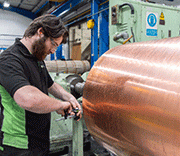
Copper-coated roll
Real terms growth has flatlined, and critical industrial capability is now at risk.
Radcliffe, Greater Manchester, December 2025: New research from BEP Surface Technologies has revealed that the UK’s electroplating and surface finishing sector is shrinking at an accelerating rate, with one in six firms lost over the past ten years and most of the remaining businesses showing no real-terms financial growth.
The findings indicate a sector approaching a point of irreversible decline, placing defence, nuclear, aerospace, and power generation supply chains at growing risk.
Analysis of Companies House balance sheets shows that of the 80 independent electroplating firms operating in 2015, only 67 remain. At least seven of those remaining firms are already insolvent or in the process of being wound up.
Across the group, combined net worth has increased only marginally over the past decade, despite inflation rising by more than 40 per cent over the same period. Most of the remaining financial strength is concentrated in the top ten companies, while the majority are barely breaking even.
The analysis reveals that the industry supporting defence, nuclear, aerospace, and power generation has remained stagnant in real terms. At the same time, costs, regulatory burdens, and skills shortages have continued to increase.
According to BEP, the figures confirm what industry bodies have been warning for years: surface engineering capability is quietly eroding and, unless addressed, the UK will face longer lead times, reduced resilience, and growing dependence on overseas finishing capacity.
Andrew McClusky, Managing Director of BEP Surface Technologies, which compiled the analysis, said the decline is now difficult to ignore.
“This industry has been slowly and quietly shrinking,” he said. “Not failing in headlines, but gradually thinning out each year, one plant at a time. Once capability falls below critical mass, it will not return. We are close to that point.”
BEP’s own balance sheet places it firmly in the top tier of the sector, with net assets exceeding £3 million and a long history of supporting nuclear, defence, rotating equipment, and wider industrial clients. However, broader data shows an industry in which many competitors struggle to remain viable, even after this year’s Chrome VI authorisation under UK REACH helped stabilise the market. Several firms have already removed plating tanks, exited chrome processes entirely, or closed following fires, restructurings, or prolonged periods of losses. Others now operate with negative equity, sustained by group support or asset revaluations rather than sustainable profitability.
This issue extends well beyond the trade itself. Surface finishing is a crucial, though often unseen, factor in maintaining UK industrial resilience. It underpins the durability, performance, and service life of turbine shafts, propulsion systems, landing gear, reactor components, and precision parts across multiple sectors. When that finishing capability is lost locally, it leads to longer downtimes, higher lifetime costs, and reduced control over critical supply chains.
McClusky added: “If a power station is waiting for a refurbished turbine shaft, or if a naval gearbox needs to be returned to service, you cannot wait three months in an international subcontracting queue. Capability is either here when you need it, or it is not. That is how serious this is.”
“The UK’s decision earlier this year to permit the continued, tightly regulated use of Chrome 6 (chromium trioxide) under UK REACH restored some stability to the sector. It prevented a regulatory cliff edge that could have quickly pushed essential processes overseas. The ruling allows companies to continue using Chrome 6 for specified applications under strict exposure limits, health monitoring, and environmental protections.”
However, while that decision prevented an immediate collapse, it did not resolve the deeper structural problems that the Companies House figures now lay bare.
“Authorisation stopped the immediate fall, but it didn’t rebuild the ground beneath us,” McClusky said. “The sector is still under strain, and without coordinated action, we will lose capability that the UK cannot replace.”
At the core of the issue are skills. Over several decades, the sector has lost two generations of practical technical expertise. Many of the remaining experienced platers, process engineers, and quality technicians are approaching retirement. Technical colleges have reduced manual engineering and workshop-based learning, while apprenticeship programmes are inconsistent and rarely aligned with the real needs of operating facilities.
Attracting new entrants is only half the challenge. The greater difficulty lies in ensuring they learn from those who still hold the tacit knowledge of process control, bath chemistry, certification routines, and finishing judgement. These capabilities are acquired on the shop floor, not from manuals or slide decks.
“You can’t learn surface engineering from a PowerPoint, or solely from the recently announced T Level qualifications,” McClusky said. “They have their place, but they are not a substitute for real benches, real plants, and real operators. Surface finishing is a hands-on discipline built on judgement, repetition, and lived experience, none of which you get in a classroom-only model. Unless the UK rebuilds proper workshop-based training, with young people learning alongside skilled operators who have spent decades on the shop floor, we will lose this knowledge faster than we can replace it.”
Despite these pressures, McClusky emphasises that SMEs in the sector are capable of modernising when conditions are favourable. BEP’s own experience with the Made Smarter North West adoption programme illustrates this. The company has upgraded CNC control systems, implemented digital monitoring for process chemistry and stability, and enhanced traceability and repeatability in refurbishment work for demanding energy and aerospace clients. These improvements have reduced rework, boosted throughput, and increased data confidence for critical applications.
“Give SMEs clear rules and a nudge on technology, and they move,” McClusky said. “We’ve seen it first-hand. The wins include better yields, fewer reworks, and faster audits. That’s how you keep capability here and make it cleaner and more competitive.”
Another challenge is profitability. Many surviving firms are operating with margins too narrow to afford new equipment, training, or compliance. Buyers’ expectations of annual savings have driven prices down to a level that now diminishes capability rather than enhances it. In several regions of the country, companies are already the last providers of their specific process, with no alternative capacity behind them. If the UK wants this capability to remain onshore, the commercial model must reflect the true cost of delivering it.
This is where the broader supply chain must take responsibility, because stabilising the industry is not just a policy challenge, but a commercial one.
To prevent further irreversible decline, BEP is calling for a national surface-finishing capability task force involving plating specialists, defence and energy OEMs, technical colleges, regulators, and standards bodies. The task force should map UK capability, restore practical training routes, tailor compliance requirements for SMEs, and ensure that any substitution decisions are supported by proven performance data rather than assumptions.
“The sector now needs realignment, with a clear understanding of where capability remains strong, where it is strained, and where intervention can prevent irreversible damage,” McClusky added. “Training should revert to practical workshops, compliance support ought to be tailored for SMEs, and substitution must be based on proven performance rather than assumptions.
“We have a narrow window to safeguard and rebuild this industry. If we don’t act now, we won’t get a second chance.”
For Information:
BEP Surface Technologies Limited
Eton Hill Road, Radcliffe
Manchester M26 2XT, UK
Tel. +44.161.724 9090
E-mail: sales@bep-st.com
www.bep-st.com