E-Archive
 BACK
BACK
Interview
in Vol. 27 - March Issue - Year 2026
Innovating in Metal Particles for Over 100 Years

Florian Götz, Innovation Director, Ervin Europe

Ervin Patent 1939
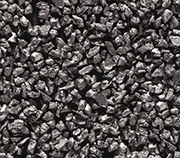
Amagrit stainless steel abrasive grit
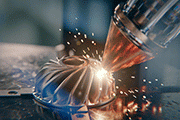
Additive manufacturing
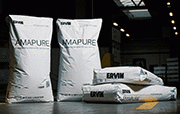
Amapure mineral degreasing additive
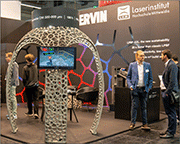
Ervin pavilion from Formnext 2025
MFN had the opportunity to speak with Florian Götz, Innovation Director, Ervin Europe.
(?) MFN: Can you tell us a little about yourself and your role at Ervin?
(!) F. G.: After graduating, I joined the German Air Force, working in roles around the Eurofighter aircraft and building my understanding of materials, joining processes, and structural integrity. I then founded a digital start-up, developing my knowledge of programming, databases and digitalisation, as well as project management.
I joined Ervin in March 2017 in a strategic role, and in January 2023 I was appointed Innovation Director for Ervin Europe. My role covers new product development, process innovation, digitalisation, and strategic projects, with the aim of turning ideas into practical, measurable value for our customers and for Ervin.
(?) MFN: Can you tell us about Ervin’s history of innovation?
(!) F. G.: Innovation has always been a defining element of Ervin’s identity. The company was founded in 1920 by John F. Ervin, who developed and patented the original cast steel abrasive process in 1939 and created the Ervin Test Machine, which remains an industry reference to this day.
In the 1940s, Ervin was active in SAE committees, defining standards for steel abrasives and shot peening materials, which enabled customers to compare performance and stabilise their own processes. More recently, Ervin has played a pivotal role in developing a brand-new ISO standard for stainless steel abrasives. Our long history of innovation includes expansion into European manufacturing, centrifugal atomisation technology, and the development of Amagrit in Europe. Ervin encourages open thinking and challenging the status quo, which fuels innovation at Ervin today.
(?) MFN: What has happened in the nine years since you joined Ervin?
(!) F. G.: In 2017, Ervin completed a rebranding while managing three European manufacturing sites from Berlin. The atmosphere felt very much like a start-up, with fast decision-making.
In 2018, I initiated the systematic digitalisation of processes at Ervin Europe, connecting and replacing systems to reduce manual work and improve performance.
Since 2019, I have been driving Additive Manufacturing activities at Ervin. Starting cautiously, we learned what works. AM still feels like a start-up within Ervin, but today we are seeing our first sales.
Amapure is another example of turning challenges into practical customer solutions. Our mineral additive binds oil and grease in the abrasive mix and removes them via the air-wash system, helping to stabilise the process and restore consistent blasting performance. It delivers improved surface quality, better coating adhesion, reduced machine wear, and lower operating risk, while also reducing the need for additional cleaning steps.
(?) MFN: Sounds like innovation at Ervin goes far beyond new products?
(!) F. G.: Absolutely. Innovation at Ervin is enabled by experimentation, learning, and development, but innovation is never an end in itself; it is designed to deliver tangible benefits for the end user—whether that user is our customer or our own employees. For example, we adopted wind power with our own dedicated turbine several years ago to support our customers’ sustainability drives.
Often, innovation means revisiting past ideas that are now viable when combined with new tools or designs. Additive Manufacturing results once considered impossible are now proven in practice. Innovation means actively shaping change rather than reacting to it.
Recently, customers have become increasingly focused on cost and value, rather than purely price. Ervin has always focused on the “Total Cost of Blasting” (TCB) of a blasting operation. We have introduced a user-friendly mobile app so our sales and technical teams can demonstrate potential customer savings from switching to a higher-quality abrasive, even where the purchasing price is slightly higher.
(?) MFN: Where do ideas come from and how do you decide which ones to pursue?
(!) F. G.: At Ervin, innovation is driven by collaboration across functions and departments, with input from customers and partners ensuring that practical experience meets customer requirements. This cross-functional exchange identifies real improvement potential, based on impact, feasibility, and timing, to ensure value creation for Ervin and our customers.
Internal innovation often starts by observing how work is actually done in daily operations. Encouraging teams to question these routines is an important part of our innovation culture.
At the Ervin test centre in Glaubitz, Germany, we welcome customers and industry partners to find and test solutions to specific challenges in their applications. Solutions have at times even surprised our technical experts, proving that there is always scope for new and better ideas.
We have also learned from partnerships with surface preparation companies, for example paint manufacturers finding better abrasive solutions to suit their product range.
(?) MFN: Why did Ervin enter Additive Manufacturing and what makes your powders different?
(!) F. G.: Additive Manufacturing has already gone through a hype phase and is now in a much more realistic stage, where its structural limitations have become obvious. For many industrial users, AM is still restricted by a combination of high material costs, limited availability of powder, restricted part size, and uncertain process economics.
We saw a clear opportunity. With our experience in producing large volumes of metal particles with tightly controlled quality and high cost efficiency, we approached AM from an industrial perspective. Our production equipment in Europe and the United States is designed for full truckload quantities, which fundamentally changes how powder cost and availability can be addressed.
We demonstrated early on that our centrifugal atomisation technology produces excellent powders for classical AM processes, and we successfully supplied several hundred tonnes to a leading binder jetting company. This proved the technical feasibility at scale and led to an important realisation: simply supplying high-quality powder does not automatically make Additive Manufacturing industrial. Without a step change in cost and scalability, AM remains limited.
We took the next step and developed Amapowder HCS, a high-carbon steel AM powder in classical particle size ranges, but at roughly 10% of today’s market prices. With patents in place and further development ongoing, this approach directly addresses the core barriers of AM—cost, scale, and industrial robustness.
Our ambition is to fundamentally improve the economics of Additive Manufacturing, enabling larger parts, higher volumes, and new applications that were previously not viable. That is how we will help AM move from a niche technology to an industrial manufacturing option.
(?) MFN: How does Ervin involve customers and partners in that AM innovation process?
(!) F. G.: From the very beginning, we understood that AM cannot be developed in isolation. The challenges we are trying to solve require close cooperation across the entire value chain. Collaboration with customers, industrial partners, and research institutes has been at the core of our AM strategy since 2019.
We are open-minded toward new projects and partnerships, seeking external input and feedback. Many valuable ideas come from discussions with customers already experimenting with AM or struggling to make it viable. By listening to and understanding their constraints, we can align our developments with practical industrial needs.
In parallel, we work closely with research institutions such as Fraunhofer and technology partners to validate concepts, test boundaries, and accelerate learning. Each collaboration contributes valuable insight. One path often opens others through a different partner or application.
Overall, AM innovation at Ervin is a co-creation process. By combining customer feedback, partner expertise, and Ervin’s industrial production capabilities, we develop solutions that are innovative, scalable, reliable, and economically relevant.
(?) MFN: Does AM for Ervin mean a new customer base?
(!) F. G.: Additive Manufacturing opens the door to new customer segments without breaking from Ervin’s traditional customer base. One of the most interesting aspects of our AM activities is how naturally they connect with the industries we have been working with for decades.
Many existing steel abrasive customers—such as foundries, forges, and manufacturers of structural or automotive components—are already active in, or seriously considering, Additive Manufacturing. For them, AM is not a replacement for established processes, but an additional tool that can complement conventional manufacturing.
From an application point of view, the connection is even stronger. Many metal parts produced by AM still require post-processing, for example blasting, to achieve the required surface quality or prepare the part for further steps like coating or assembly. Ervin can support customers along the entire value chain—from metal powder for printing, process know-how, to surface finishing with steel abrasive.
AM extends our traditional business, opening new opportunities built on our established trust and technical expertise.
(?) MFN: How has the market responded so far?
(!) F. G.: In 2025, we presented our Additive Manufacturing developments to a broader audience for the first time at events such as PM2025 in Glasgow and the world’s leading AM trade show, Formnext in Frankfurt, where, together with Laserinstitut Hochschule Mittweida (LHM), we showcased the largest powder-bed metal printed part produced to date. For us, this was an important step, as it marked the transition from internal development and pilot projects to open market validation.
The breadth of feedback across many industries confirmed that we are addressing real industrial challenges, and many discussions quickly moved beyond general curiosity to concrete technical and economic questions—which is exactly where Additive Manufacturing needs to be if it is to become truly industrial.
(?) MFN: Where do you see the future of Ervin in Additive Manufacturing?
(!) F. G.: We see a clear role for Ervin in helping Additive Manufacturing move toward a truly industrial manufacturing option by addressing the fundamental limitations that have held AM back for years. We can reopen AM for industries such as construction steel, automotive, or heavy equipment that previously ruled it out. We also see significant potential in adjacent applications, such as wear-resistant coatings. Applications like stainless-steel-coated brake discs for electric vehicles show that AM and surface engineering can combine to deliver both performance and sustainability benefits.
(?) MFN: Looking ahead, beyond Additive Manufacturing, what can we expect from Ervin?
(!) F. G.: Ervin’s future is shaped by sustainability, efficiency, and intelligent use of materials. Many of the initiatives we are working on today are a natural continuation of Ervin’s long-standing focus on durability and resource efficiency. We continue to optimise recycling loops and material efficiency, along with the use of renewable energy, to further reduce environmental impact. We are investing in capability and infrastructure, such as the expansion of our test centre, to gain deeper insights into blasting processes, validate new developments, and support customers more effectively. The digitalisation of our production and AI-based tools will improve process stability, quality consistency, operational transparency, and, most importantly, energy efficiency.
(?) MFN: It sounds like you will be very busy for the foreseeable future?
(!) F. G.: Without doubt. The second half of this decade will be very exciting. We have no time to wait and see; we must act now.
I am very optimistic that Ervin is in excellent shape to deal with current and future challenges, just as we have done for more than 100 years, thanks to our flexibility and ability to adapt to changing markets.
MFN would like to thank Florian Götz for this interview!
For Information:
Ervin Germany GmbH
Rudower Chaussee 48
12489 Berlin, Germany
Tel. +49.30.400 37846
E-mail: info@ervin.eu
www.ervin.eu