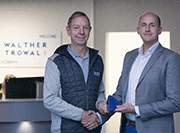
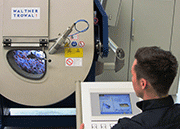
Michael Becker has been a fixture at the Walther Trowal Test and Training Center (TTC) for more than 28 years – first as second-in-command and then as its manager. This summer, he will retire. At that time, Maximilian Beien will assume the management of the TTC. This presents a good opportunity to look at the development of surface refinement technology over the last few decades and to discuss future technological trends.
(?) MFN: Michael, what is the reason to maintain a test and training center at Walther Trowal?
(!) M. Becker: The origin of the TTC goes all the way back to the year 1931, when Carl Kurt Walther founded our company in Wuppertal. The starting point was a patent for the so-called “Pioneer” rotary drums, which, for the first time, allowed surface refinement processes such as painting, metalizing, burnishing, and deburring to be carried out mechanically on an industrial scale. As is still the case today, at that time customers purchased not only a machine but an entire process, the feasibility of which had to be proven through processing trials.
The fact that the entire finishing process is always at the center of the company’s activities is also reflected in the fact that the term “trowalizing” became a protected trademark. The expression “Trowal,” as part of the company name “Walther Trowal,” represents an abbreviation of the German term “TROmmel WALther,” a distinct reference to the rotary drum (“Trommel”) as the basis for the company’s business activities.
(?) MFN: What characteristics make the TTC special?
(!) M. Becker: Walther Trowal is one of the very few companies that offer not only equipment but also media, compounds, and services. We always look at the entire finishing process. Maintaining a TTC allows us to legally guarantee to our customers that the results of our processing trials can always be replicated in their daily production.
Surface treatment — I would call it “surface refinement” — is an extremely complex technical task that calls for highly individualized solutions. We are aware that processing trials can be very time-consuming and costly before satisfactory results are achieved. But what counts is that the customer gets a well-functioning and cost-efficient process. This empirical approach, and the close proximity to the users of our technologies, have been the reason for our success.
(?) MFN: Have the customers become more demanding over the years?
(!) M. Becker: When I started at Walther Trowal, the drawings contained a remark that the workpieces must be trowalized or undergo a rotary drum operation. Usually, these remarks made no reference to the processing parameters or processing goals. Basically, this meant that the workpieces were dumped into a finishing machine to be processed and then discharged after a certain period of time. Frequently, they had to be returned to the machine for rework. Such a haphazard approach is no longer possible.
Today, customers come with specific demands such as clearly defined edge radiusing or surface roughness values and/or a certain brightness. All these goals must be achieved in a sustainable manner. Moreover, the workpieces coming out of the machine must be dry, clean, and free of any damage in the form of nicks or scratches.
(!) M. Beien: Since today’s customers expect a high degree of automation, two aspects—crucial for trouble-free manufacturing operations—are frequently overlooked or do not receive the attention they deserve: the grinding or polishing media must not get lodged in the workpieces, and the finished workpieces must be reliably and completely separated from the media. Also, workpieces from one batch must not get mixed up with workpieces from another batch.
In trial reports from the 1990s, one can frequently find the remark, “may require manual support of the separation operation.” Today, something like this is unthinkable. Higher labor costs and automation requirements demand the development of screening and separation devices that guarantee absolutely reliable separation of the media from the workpieces. The possibility that individual workpieces might get tangled up with each other must be completely eliminated. Moreover, customers demand that after completion of the finishing process, the entire workpiece batch is discharged from the machine without any “stragglers” left inside. We achieve this 100% unload goal perfectly with our CB rotary vibrators through the optimal setting of the imbalance weights. In this respect, our work at the TTC helped us gain valuable experience. As a matter of fact, during the past years our TTC has pioneered numerous new technical developments.
(?) MFN: How would you describe your TTC today?
(!) M. Becker: Our team at the TTC consists of colleagues with different backgrounds and ages, from our youngest colleague, a student who works between semesters, to an old-timer like me, who will retire soon. The difference in age and outlook allows us to combine decades of experience from older colleagues with the sometimes somewhat “unusual” ideas of younger ones. This difference in mentality helps us always find the best finishing solution for customers. The mix of colleagues with extensive hands-on experience and team members with an academic background guarantees solutions that are innovative but, at the same time, very practical.
Our TTC in Haan is equipped with a broad range of mass finishing and shot blast machinery, as well as coating systems for mass-produced small parts. Of course, this also includes peripheral equipment so that, for example, after a mass finishing process we can dry and coat the same workpieces. Last but not least, we are always able to propose optimal solutions for cleaning and recycling process water. In our technical lab, we have tactile and optical measurement devices that allow us to carry out all kinds of precise measurements, for example, edge radiusing expressed in micrometers and surface roughness readings.
(?) MFN: How do you plan and conduct actual processing trials?
(!) M. Beien: Based on the customer requirements or specifications, we analyze which machine and processing media might be best suited for a given task. We also consider material-handling aspects, for example, what degree of automation the customer expects. Based on our initial analysis, we then run processing trials, either with small samples or with large workpiece batches reflecting the actual production conditions at the customer’s site. In our trials, we always try to consider all aspects of a process, including workpiece handling and drying, as well as cleaning and recycling of the process water. With coating projects for small parts, the most important aspect is always the determination of the optimal process parameters, such as the selection of the most suitable lacquer, operating temperatures, or batch sizes. And of course, we usually conduct processing trials free of charge.
Our guiding principle is always to develop total—not only partial—solutions that work well under actual production conditions. In this respect, we rely on the expertise of other departments, for example, engineering and process water treatment. The colleagues in our chemical lab select the optimal compound and, if necessary, develop new ones.
(?) MFN: When do you decide that a process developed by you is ready for implementation?
(!) M. Becker: Actually, never! It is always the customer who evaluates the results of our processing trials. After he is satisfied that the proposed process will work with his workpieces, we then tweak the entire process. For example, we try to reduce the cycle times and determine the optimal balance between finishing quality and cost-efficiency.
(?) MFN: Please give us some examples.
(!) M. Becker: Since we conduct hundreds of processing trials, I can name numerous positive examples. We have many customers who were not aware that, through mass finishing, shot blasting, or coating, the functionality and appearance of their products could be improved. Today, they are satisfied customers who, by utilizing our technologies and equipment, have been able to significantly enhance the quality and cost-efficiency of their products.
A good example is an automotive supplier. He is treating spikes for winter tires—about two mm thick and five mm long—in a rotary vibrator, with up to 50,000 pieces in a single batch. To ensure that batches with different workpiece sizes do not get mixed up, the machine must be completely unloaded. Not even one spike can be left behind. We successfully solved this problem. Later on, the same customer started producing spikes with a thickness of 1.3 mm. Initially, the machine was not designed to handle such small components. But by modifying the separation system, we were able to reliably treat the smaller spikes.
Other successful examples include the deburring of heavy but delicate door hinges for a renowned manufacturer of SUVs, the surface smoothing of plasticizing augers for injection molding machines, and the polishing of art objects made by famous artists.
(?) MFN: Is the TTC also developing brand-new processes?
(!) M. Becker: Yes, our TTC was instrumental in developing several new processes—mostly based on tasks for which our customers had requested our help. In this respect, very important is the close cooperation with our chemical lab. For a long time, high-gloss polishing of automotive parts made from zirconium oxide ceramics was only possible by hand. A company making such components had not even dreamed of mechanizing and automating such a difficult polishing task. For our processing trials at the TTC, our colleagues from the lab successfully developed processing media for this specific polishing application. Today, the process developed by us runs fully automatically at this manufacturer. As a matter of fact, the same media is used for polishing orthopedic implants and even components in luxury wristwatches.
(?) MFN: The second “T” in “TTC” stands for training?
(!) M. Beien: During my time at the university, I had never heard anything about mass finishing. The same is true for most of our customers. Since professional schools and universities do not cover this field in their curricula—admittedly, it is a highly specialized niche technology—we offer training seminars free of charge.
Now and then, the trainings are conducted by video conference. But hands-on seminars here in Haan or at our TTCs in the United States or Mexico are much more productive, because the participants can do practical work with our equipment and processing media. For example, they can see firsthand how changes to the imbalance weight settings or different media affect the finishing results.
(?) MFN: Do you also have an academy?
(!) M. Beien: We had considered establishing a training center that regularly conducts seminars, for which we would charge a fee. But we decided against this, because we prefer a pragmatic approach. Our customers are looking for solutions for their specific finishing requirements. For this reason, we conduct our training seminars for individual persons or small groups of people specifically dealing with their products.
Thoroughly training the people who will operate the finishing systems after they have been installed is also very important. In this respect, commissioning the equipment at the customer location is very helpful, because right from the beginning it helps to build trust with the operators.
(?) MFN: What new trends are you looking for in the TTC?
(!) M. Beien: Robotic handling for loading and unloading of the workpieces, but also during the actual finishing operation, is becoming more important. Regarding the latter, in a new finishing system we are utilizing a rotating processing bowl filled with media. A robot grabs the workpieces—one or two at a time—and holds them in the moving media mass in the processing bowl. This not only generates extremely high pressure between the media and the workpieces but also helps automate the entire process, including the transfer of the finished workpieces to a drier.
(?) MFN: What do you expect for the future?
(!) M. Beien: Besides the big subject of “surface refinement,” automation of the entire process, including workpiece loading and unloading, plays an extremely important role. This is of particular relevance for Europe, because automation will help to lower personnel costs and alleviate the shortage of skilled labor.
Many experts consider additive manufacturing a potentially huge market for surface finishing. The components coming out of a 3D printer generally have a very rough surface, which must be made smoother and, frequently, polished. The aerospace and medical engineering industries have been pioneering this new manufacturing technology. But so far, except in a few instances, 3D printing has not been used for high-volume production. Besides additive manufacturing, the classical subtractive methods—milling, turning, drilling—will continue to play an important role. With large production volumes, they are still more efficient.
(?) MFN: What are the main drivers at Walther Trowal for the development of innovative finishing technologies?
(!) M. Becker: We develop innovations in close dialogue with users. Our customers come to us with specific challenges. We use these to develop new processes that have repeatedly shaped our industry. Trust-based cooperation and practical relevance always form the foundation.
MFN would like to thank Michael Becker and Maximilian Beien for this interview!
For Information:
Walther Trowal GmbH & Co. KG
Rheinische Str. 35-37 42781 Haan, Germany
Tel. +49.2129.571-209
E-mail: g.harnau@walther-trowal.de
www.walther-trowal.com




 BACK
BACK