Wheelabrator’s aerospace peening team delivers super-high-spec peening processes to aerospace OEMs, MROs, and suppliers. From bases in the UK and France, and a growing manufacturing and support footprint in additional regions, it provides cutting-edge airblast equipment, parts, expertise, and—crucially—subcontract shot peening services to a global customer base. Yves Dufour, who heads up the equipment business, and Tony Grammauro, his counterpart on the subcontract peening services side, collaborate closely to advance aerospace peening processes and stay ahead of new and emerging requirements. At a pivotal moment for the aerospace industry, this specialist team is primed to take a key role in bridging capacity and capability gaps in high-spec peening.
Capability and Capacity: The Double Pinch
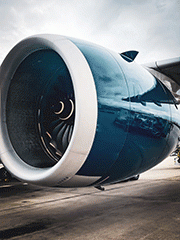
Five years on from a global pandemic that saw fleets grounded and uncertainty peak, the aerospace industry is booming. Manufacturers are ramping up volumes to build the “missing fleet” that, according to the IATA, is currently reining in growth in commercial aviation. MRO capabilities are expanding as airlines delay retiring existing aircraft and fleets are growing. Major new engine programs are on the horizon, bringing new components and new requirements.
The problem: the supplier capacity to deliver these volumes is not there. And for specialist processes like shot peening, the capacity pinch meets a capability pinch. More complex parts and more exacting specifications require ever more precisely controlled peening processes. At the same time, skilled peening operators are in short supply and certification processes have become more rigorous, making it harder for new suppliers to add capacity or for existing ones to expand their capabilities.
Yves summarizes the situation: “Over the next 5–10 years, we’ll see volumes of new aircraft increasing dramatically and suppliers must be able to accommodate that extra volume. We’ll also see new engine programs from major manufacturers – Safran’s LEAP and RISE programs, or Rolls-Royce’s UltraFan, for example. The goal of these programs is to develop new engines for existing aircraft models that dramatically improve fuel efficiency and are ready for alternative fuels like SAF. But to achieve that, engine components are getting incredibly complex and high-spec, with the peening specifications to match. So there’s real volume hitting supply chains soon and for some of the new programs, the supplier base is not established yet. It’s a huge opportunity for suppliers – if they can keep up with the complexity.”
Bridging the Gap
Wheelabrator’s subcontract shot peening services can often step in to deliver critical treatment of parts when the capability doesn’t exist in-house, volumes are too small, or a little extra capacity is needed. In anticipation of the ramp-up, the team has built out capacity and now offers NADCAP-accredited aerospace peening from two sites, in the UK and France.
But it’s the team’s unique dual ability to treat parts and deliver equipment for new processes that may unlock some of the industry’s pressing capacity issues. This is true for MROs, who might be building out new facilities, but also for new products and aircraft. The challenge is the same: the demand is here, but the capacity to meet it is not. Not yet.
Tony explains: “We’re currently working with a drone manufacturer who has developed a new drone that requires shot peening. They’re keen to move into production, but they have no peening experience at all in-house, so we are advising them on what they should do in terms of treatment. It's very likely that the first parts will be produced at our facility, giving them the time to refine what they need to do internally to buy the right equipment and build in-house capacity for a smooth production ramp-up.
“Thanks to our unique set-up, we can advise them throughout that whole journey, because it's not just about producing a machine or just delivering the treatment. It's a whole package of expertise that needs to be embedded in their production.”
From First Peened Part to Approvals
The team is expecting this scenario to become more common in the traditional aircraft supply chain too. As new engine programs and new aircraft manufacturing take off, components will be hitting Tier 1 or Tier 2 suppliers with shot peening specifications they can’t yet meet or don’t yet have the approvals for. In this scenario, the Wheelabrator team can step in to provide the treatment, while also helping the supplier build up capabilities in-house, get them through approvals, and train operators.
Yves thinks this is where the Wheelabrator team is uniquely positioned to help: “It’s very difficult to get these specialist processes approved, so even if a supplier makes the decision to build up capabilities in-house, there will be a significant time lag. We can give them the equipment to run the process, but they still need the approvals. We can provide the treatment for them initially and then get them where they need to be to take the process in-house. It’s this end-to-end support that I think will make a difference to the speed with which the supply chain can adapt to new demands.”
Going "Glocal"
According to Tony and Yves, these capability and capacity gaps will start opening up everywhere, with demand for aerospace peening equipment rising in tandem with the growing fleet. And while the majority of engine manufacturing and much of the aircraft assembly is still concentrated in Europe, the demand/supply gap when it comes to peening processes is an increasingly global issue.
Major engine manufacturers are investing in new or expanded MRO hubs across several continents. Many OEMs and MROs want equipment built locally, to minimize transport emissions associated with the equipment and reduce supply chain risk. All this means demand for critical aerospace peening processes is more global than ever. It’s why Yves and Tony are expanding their team’s own technical and sales support footprint and are leveraging Wheelabrator’s wider manufacturing network to build specialist equipment local to where it will be deployed.
A recent example is a giant Wheelabrator wing peening machine (Figure 3) that was manufactured in China for a local customer – the imposing result of successful collaboration between the manufacturing team in China and the aerospace team in France.
More Automation
The global deployment of high-spec peening processes is all the more impressive when viewed against the backdrop of an extreme shortage of skilled operators. Increased automation is the secret. As the industry struggles to recruit or train people with the right level of peening expertise, the equipment itself must deliver more of that expertise, say Tony and Yves.
Yves expands: “The demands on repeatability and precision are reaching new heights, while skilled operators are hard to find. That means we really need to bake a lot of the operator skill into the equipment and improve the ease with which it can be run. Of course, the high degree of automation makes the process more efficient, too, which in turn helps with capacity. Tony and his team have invested in our latest equipment for their operations to increase capacity, despite having no shortage of peening expertise!”
Machines with a high degree of automation and process control mean fewer operators can run more processes at once, and faster. This trend towards more sophisticated equipment is aided in part by the fact that aerospace customers increasingly take an equally sophisticated view of equipment costs.
Tony elaborates: “Over a 20-year operating life, the operating costs of an (airblast) shot peening system make up 95% of the total cost, dwarfing the initial investment. So of course we, as users of the equipment, want to know what it’s going to cost us to run the process, how much media, energy, and maintenance effort the machine will need. It’s something aerospace equipment buyers have built into their decision-making process a lot more, which is good for us, because what we build – and what the industry needs – is high-tech, high-quality equipment that can’t ever be ‘cheap’. But it can pay for itself in saved labor cost, reduced maintenance, better use of resources, and more. A tightly controlled, stable process tends to be the most efficient. And we’re really good at that.”
On this last aspect, too, the close collaboration within the Wheelabrator aerospace team – across subcontract peening, equipment, and aftermarket – enables new solutions to emerge faster and improvements to materialize sooner. Feedback from running the equipment quickly makes its way back into product development. Emerging requirements, like new materials or more complex parts, can be tackled jointly, speeding up process development.
Yves concludes: “We’re a close-knit team, with deep specialist expertise and access to incredible global infrastructure. We’ve always counted ourselves lucky to be working in this industry, championing shot peening as a critical process. Now our moment has come to give back. Our unique capabilities mean we can help build supplier capacity, so the industry can fulfil its potential.”
For Information:
Wheelabrator
20B rue Camille Didier
FR-08000, Charleville Mezieres, Frence
Tel. +33.3.24 33 63 00
E-mail: contact.fr@norican.com
www.wheelabratorgroup.com




 BACK
BACK