
E-Archive
 BACK
BACK
Articles
in Vol. 27 - March Issue - Year 2026
Evaluating the Basics
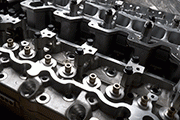
The internal combustion engine has several components that have traditionally been shot peened. Electric vehicles present other components in a simplified transmission and suspension for shot peening
Background
For those of you that have followed the author’s publications over the years, you might be familiar with certain consistent themes—the health of the industry, its pace, and whether stakeholders are keeping up with it, the future of the industry, and specific highlights on activities among specialized manufacturers within blast cleaning and shot peening. An effort has been made to remain optimistic, albeit with a realistic expectation of the industry. Often, parallels are drawn with other related industries to benchmark industry progress. Some popular discussions over the years pertain to Artificial Intelligence, Electric Vehicles, Industry 4.0, and automation, each with its unique influence on industry performance. However, the topic this time is going to stray from the above trend. This topic is driven by a recent training session with a company that was recently introduced to shot peening in a modest fashion. The simple suction blast system that was being used, and the company’s earnestness to develop the “right” process, provided the fuel to draft this article.
Often, when talking about fatigue, residual stress, inline velocity measurement, closed PID loops, and anything else you can imagine as adding sophistication to your peening process, the possibility that some users are just starting off in their shot peening journey may be overlooked. This discussion is aimed at those users, as well as routine shot peeners, to evaluate their current process with the potential for improvements.
Interpretation of Basics – Process and Equipment
Whether your process involves blast cleaning a component for a downstream coating or inducing compressive residual stress to address impending fatigue failure as with shot peening, the underlying influencers are the same—mass and velocity. These two parameters determine how well your component is cleaned and the effectiveness with which uniform residual stress is generated within it during peening. Always remember, ½ × mass × (velocity)² is a critical formula that governs your process. Therefore, so long as you monitor and control these variables and their determinants, you will be able to guarantee repeatable and consistent results.
One part of the equation is the process, while the other critical area is the equipment that you choose to conduct the process with. A significant portion of the author’s career has been spent recommending suitable machinery to customers for custom applications around the world, resulting in a reasonable understanding of the efficacy with which each solution might work. Though there are no rigid rules in selection, please consider the following as a checklist of sorts:
• Applications with high production volumes in shot peening and blast cleaning are better addressed with wheelblast machines. On the other hand, targeting small areas requiring peening in a high-volume application is accomplished with automated airblast systems.
• Non-metallic media blasting (grit blasting or etching) applications are almost always with airblast machines.
• There are several applications that could be served equally well with airblast or wheelblast machines. Keep an open mind; your specific circumstances will address the question (e.g., commonality with other machines in your shop, compressed air constraints, etc.).
• Be open to the possibility that your application might be better served by a non-conventional peening tool, such as rotary flapper (small areas to be peened in low volumes), ultrasonic peening, laser peening, vibratory peening, etc.
No matter which process you choose to employ, process control is important to produce a component in a repeatable, consistent, and accurate fashion.
Process Control – Consistency, Repeatability, and Accuracy
When the author first started in this industry, the term “quality control” was highly prevalent. Unfortunately, quality control was an after-the-event assessment, leading to part rejection when components did not pass the quality checks. At that stage, it was too late. The user by then had already invested a significant amount in value addition before the part was deemed a “reject.”
This led to the creation of the more updated and proactive concept of “quality assurance.” A well-designed peening machine is built with sub-systems that “assure” quality. Let us evaluate how this is done.
½ × mass × (velocity)²
Mass – this pertains to the size of media used for peening. Any inconsistency in size that is outside the allowable tolerance defined by commonly used specifications (AMS and others) spells trouble for the above equation. Monitoring of this size happens in several stages.
a. New media (AMS grade) used in a shot peening machine is certified for conformance to AMS 2431/x by the manufacturer for size, hardness, chemistry, etc. Additionally, certain aerospace primes require the end user to repeat screening at site with five sieves before the media accepted for use. Process specifications also dictate the duration for which this media must be sieved (five or ten minutes, based on the media size) to accommodate potential screen blinding.
b. Further, in-process media is screened (with two sieves) as peening progresses in the machine (in-use media). The frequency of screening is dependent on whether the machine is designed with maintenance tools such as a screener or vibratory classifier, the absence of which increases the frequency of screening.
c. In addition to tests for size using sieves, both new and in-process media samples are evaluated for shape. Shot peening requires spherical media particles that “dent” the surface, not sharp particles that could nick it and create stress risers. Therefore, although somewhat primitive, particle inspection is carried out under 10–30× magnification.
d. Both screening and shape inspection techniques are being re-evaluated by SAE and AMS committees in consultation with academic institutions to devise optical and other methods of evaluation for better accuracy and repeatability. It will not be long before such technologies enter mainstream production floors and remove the subjectivity from results.
e. Shot classifiers or screeners have been in use for a long time and are quite effective in size classification so long as they are not overloaded or damaged by plugs or tears in their sieves. Spiral separators eliminate non-rounds from the media mix. This unit is gravity-driven, with little opportunity for failure, but is affected by its capacity to handle media volumes greater than a few pounds per minute. In other words, they are ideal for sampling. Optical means indicated earlier could eliminate all these issues and should be encouraged for adoption when maintaining this critical input to shot peening.
f. Media maintenance also involves maintaining constant media flow, whether through orifice plates in a suction blast machine or precise flow control valves in an airblast or wheelblast machine. Most valves used within the industry are closed loop, with correction capabilities when values stray outside preset limits. It is important to note that media flow variation will affect intensity in an airblast machine. This is not as much of a concern with a wheelblast machine, up to a certain extent after which the motor capacity is challenged.
g. Specifications and audits will require you to conduct regular, physical drop tests of media flow to confirm that the digital display matches the actual flow through the valve(s).
Velocity – The discussion around stable shot media (uniform size, shape, etc.) is common to both wheelblast and airblast machines. However, this is not the case with velocity. The determinants, as well as the means to monitor and control it, vary between the two media propulsion techniques. Meanwhile, for other non-conventional peening techniques such as rotary flapper peening, velocity is directly proportional to the rotational speed of the mandrel.
a. Most airblast shot peening machines are designed with a closed PID (proportional–integrative–derivative) controller. A PID controller is a feedback loop designed to continuously control and automatically adjust variation from a preset value and return it to the desired set point. In this case, this could be to maintain 40 PSI (2.75 bar), for example, that may be required by a particular recipe or technique.
b. Though wheelblast machines are not commonly seen in aerospace, they are widely used in the automotive industry. The velocity generated by a blast wheel is tangential and directly proportional to the wheel diameter (distance from the tip of one blade to the one that is diametrically opposite) and wheel rotational speed. Most wheelblast peening machines (and some modern cleaning machines) are fitted with variable-frequency drives that allow motor speed alteration to change velocity and resulting intensity. Wheel diameters are fixed.
c. The blast wheel is comprised of several internal parts, some fixed and others that rotate with at the wheel speed. The condition of the different parts will affect media delivery. For example, the condition of the blade/vane/paddle in the blast wheel will affect the flow pattern of the peening media. Grooves or holes in the blade will reduce the velocity with which peening media is propelled out of the blast wheel.
d. Wear of other components, such as the control cage and impeller, will also affect flow pattern and correspondingly influence blade wear. Manufacturers’ recommendations for wheel inspection and maintenance must be strictly followed for effective peening.
Calibration – Your machine could be fitted with all the above controls. However, without proper calibration, the accuracy of such control tools could be severely hampered. Most users have an annual practice/requirement for calibration. All control components, from a sophisticated pressure transducer to a simple stopwatch and weigh scale used in media drop tests, must be calibrated, with a record of calibration maintained in your archives. Your process auditor will want to verify this during an audit.
The author would like to conclude the discussion with a personal anecdote for educational purposes and to validate that this discussion is, in fact, not AI-generated! During a visit to a large railway facility in an undisclosed location several years ago, an enquiry was made regarding their practice of plotting saturation curves. The response was unanimous that a saturation curve had indeed been plotted. The curve was shown (these were days before computerized curve solvers) on a piece of laminated paper, which led to the next question. A request was made to see some examples of peened Almen strips. After a flurry of discussions amongst themselves in a language that was foreign to the author, an introduction was made to “the Almen strip,” encased in a well-preserved wooden case. This strip had excellent coverage and was preserved like a trophy. It was only then that it was learned that this was the strip saved from the time the machine was first installed. Since there had been no change in the process parameters, the customer, incorrectly, did not see any reason to verify the strip, let alone plot a full saturation curve.
The discussion concludes with a clear message: shot peening, though not as complicated as other processes such as CNC machining or XRD, great benefits can be derived from its simplicity that so long as proper control of the factors that matter the most—media and velocity are adhered to.
For Information:
Applications Engineer, Ervin Industries
Tel. +1.905.483 6890
E-mail: kbalan@ervinindustries.com