
E-Archive
 BACK
BACK
Good Vibrations
in Vol. 27 - March Issue - Year 2026
FAQ: What Media Should I Use?







The most frequently asked question I receive—during seminars, trade fair presentations, and through web inquiries—is some version of, “What media do I need to process my parts?” The person asking the question typically expects a simple, to-the-point answer. However, selecting the right media involves many factors.
The methodology outlined below should be viewed as a treasure map that brings you within striking distance of the answer. Certain parameters will guide you down the path, but ultimately, experience and judgment are required to uncover the “treasure” that defines the optimal process.
I. Choosing the Process
The first step, simple deburring or overall surface improvement, may be the result you are seeking, or you may require edge deburring along with a final surface that is bright or polished which is usually a second step. The terms polish and burnish are often confused and, in some cases, are used to mean the same thing—a bright surface.
Regardless, achieving the desired result may require combining multiple process steps. Each step, however, must be considered independently when selecting media, while also accounting for the effects of the preceding step. (Chart I)
II. Choosing the Master Composition
In general, the focus will be on the primary categories of plastic, ceramic/porcelain, and dry polishing media. (Chart IIA) The part material typically dictates the media composition which best suits the grinding or polishing of such. (Chart IIB)
To determine the process and number of required steps, it is necessary to define the process type and, in some cases, to establish the range of the initial surface condition and the acceptable final finish. These factors will dictate whether one, two, or three processing steps are required. Follow the path separately for each step.
III. Choosing the Media Function (Grit) — Similar to Selecting Sandpaper
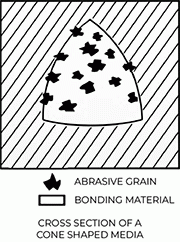
Determine the function of the process you are performing and the level of finish you wish to achieve. Media are formulated with variations in abrasive type, grit size, and bonding agents, and are then formed into specific shapes and sizes. The abrasive is distributed throughout the media body.
In general, the faster the grinding action, the faster the media wears and the rougher the resulting surface finish. The mildest media tend to be burnishing media. Remember, you cannot have the best of both worlds—namely, the fastest grinding action and the finest surface finish.
For example, if you select the fastest-cutting media to achieve the shortest deburring time, the resulting surface will be rougher, and a second process step may be required to burnish or polish the part in the final stage. Each media supplier uses different designations for their formulations to correspond with the outcomes defined by your process selection chart. (Chart III)
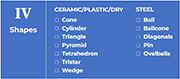
IV. Choosing the Shape
Ensuring contact with all edges of the part geometry that require deburring is the primary consideration when selecting media shape. If the objective is to achieve a specific overall surface finish, the media geometry should create a microscopic line of contact against the surface or edge. For example, flat media in contact with a flat part surface is generally ineffective.
Think of the media as a shaped abrasive file held in your hand and applied to the part. Select from the available shapes, ranked from most to least commonly used, based on how effectively they interact with the part geometry. (Chart IV)
V. Choosing the Size
The media load in a machine is dynamic. As the media operates over time, it gradually wears and becomes smaller. As media size decreases, the effective media load is reduced and requires either:
(1) the addition of new media to maintain a consistent machine load, or
(2) a complete change-out of the media load.
Option (1) results in a process load with a range of media sizes.
Option (2) provides a means of maintaining media size within defined parameters, based on overall process time.
Touches: The greater the number of media-to-part contacts, the more work is performed.
Separation: The most efficient processing occurs when the media can pass through a sieve that retains the parts—or vice versa.
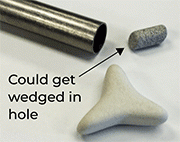
Wedging: This occurs when the media size allows it to become trapped in a hole, groove, slot, or other part geometry.
Classifying: A method of passing the media load through a sieve to separate small, worn media from functional process media.
Energy vs. Work: As media size decreases, the machine’s energy is distributed over a larger number of contact points, reducing the amount of work performed on the part.
VI. Equipment Changes the Choice
The energy of a machine may be adjustable, but its maximum energy level is fixed by the machine type. The higher the available energy, the more work the media can perform. If, at this stage of developing a process, a different machine type with a different energy capability is selected, return to Section V and choose smaller or larger size. (Chart VI)
VII. Off the Beaten Path
Dry finishing is often selected to avoid the issues associated with handling wastewater effluent generated by wet grinding or burnishing processes (then return to Section III).
Burnishing with steel media is the fastest method for inducing a visually bright shine on a part that does not have a specified surface smoothness requirement (then return to Section IV).
Compounds are a factor that must be considered in the process, usually independent of the media type (with the exception of steel media), but always in conjunction with the part material and the intended process function.
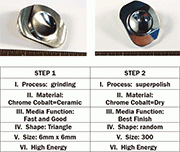
VIII. Example:
The best approach to finding the right solution for your finishing needs is to partner with the right source—one that has experience with a wide range of materials, across multiple industries, and with all relevant equipment types.
Good Vibrations
by Steve Alviti Sr
Contributing Editor MFN and
President and Owner of Bel Air Finishing Supply Corporation
E-mail: salviti@belairfinishing.com