
E-Archive
 BACK
BACK
Off the Beaten Track
in Vol. 27 - March Issue - Year 2026
A Brief History of the Watch
For most of human history, time was not something to be managed. It was simply observed.
The sun rose, and people woke up. The sun set, and people rested. Seasons changed, crops were planted, festivals arrived, and life adjusted itself accordingly. Time existed, but it did not interrupt. It did not demand attention. No one asked how “productive” the day had been.
Early attempts at timekeeping reflected this relationship. Sundials, water clocks, and hourglasses did not command obedience; they merely indicated passage. If you missed a moment, time did not punish you. A cloudy day could defeat a sundial, and no one took it personally. The first real shift occurred in medieval Europe during the 13th and 14th centuries, with the appearance of mechanical clocks mounted on church towers and town halls. These clocks were not designed for precision or efficiency. They were instruments of regulation. Bells marked prayer times, work hours, and communal routines. Time became mechanical and public, shared by everyone within earshot. Still, it remained fixed in one place. You could walk away from it.
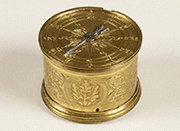
That possibility disappeared in the early 16th century. Around 1510, Peter Henlein developed early spring-driven portable timepieces, later known as Nuremberg Eggs. By modern standards they were inaccurate, heavy, and impractical. But they changed one thing forever: time became portable. Carrying a watch was less about knowing the hour and more about making a statement. It suggested importance, discipline, and control. Accuracy could wait.
It did not wait long.
In 1657, Christiaan Huygens introduced the balance spring, dramatically improving timekeeping accuracy. Watches became reliable enough to be trusted. Time was no longer approximate. It started to matter.
In the 18th century, time took on a more serious role. At sea, inaccurate timekeeping could mean disaster. John Harrison solved the longitude problem with the marine chronometer, allowing sailors to determine their position accurately. Time was no longer just about coordination or prestige. It was about survival.
The industrial age accelerated everything. By the mid-19th century, railways demanded synchronization across cities. Local time was inconvenient; standardized time zones became necessary. In the 1840s, clocks across regions were forced to agree. Punctuality transformed from a personal habit into a social expectation. Being “on time” became a measure of reliability and character.
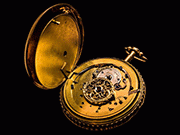
The wristwatch arrived quietly but decisively during World War I. Soldiers needed hands-free coordination. Pocket watches were impractical in trenches. Strapping time to the wrist was a functional decision, not a fashion statement. After the war, civilians adopted the habit. Time moved from the pocket to the body.
The 20th century brought speed and precision to extremes. Mechanical craftsmanship reached remarkable levels, but electronics soon overtook it. Quartz technology, introduced commercially in 1969 by Seiko, made watches extraordinarily accurate, affordable, and ubiquitous. Atomic clocks later pushed accuracy into a realm far beyond human perception. Timekeeping errors became scientifically negligible.
Human anxiety did not.
Today’s smartwatch represents a final transformation. The watch no longer simply measures time. It tracks steps, monitors sleep, counts heartbeats, vibrates with reminders, and interrupts conversations. Time is no longer a quiet reference. It has become interactive. Sometimes intrusive.
Through all these changes, one fact remains unchanged: time itself did not evolve. A minute today is exactly the same length as a minute thousands of years ago. What changed was our relationship with it.
We began by observing time. We progressed to measuring it. Eventually, we started organizing our lives around it.
The watch was invented as a tool of convenience. Stress was not part of its original specification. Yet the more precisely we learned to measure time, the more uneasy we became about living in it.
Occasionally, when a battery dies or a watch is forgotten on a bedside table, something subtle happens. Conversations stretch. Meals slow down. Silence feels less guilty. Nothing essential collapses.
The sun still rises on time. It just doesn’t send notifications.
That may be the quiet reminder hidden inside the long history of the watch: time has always been moving. It never asked us to hurry.
Rishabh Shah, MFN Trainer and Head of Operations of Daksha: rishabh.shah@daksha.net