Gears are fundamental to mechanical transmission, and shot peening is a critical process for enhancing their fatigue strength and wear resistance. Peentech Group has built long-term expertise in gear shot peening. In this interview, MFN speaks with Leo Ge, CEO of Peentech, about the company’s development and its perspective on the evolution of gear shot peening in China.
(?) MFN: Leo, nice to meet you! Could you briefly introduce Peentech Group to our readers?
(!) L. G.: Thank you for MFN’s interest. Founded in 2010, Peentech Group focuses on the development of shot peening technology. Starting with automotive gear shot peening equipment, the company has grown over the past 16 years into an integrated group with two brands, three manufacturing bases, four laboratories, and six business divisions across China, supported by 11 factories nationwide. We employ 210 people, including two PhDs, and achieved revenue of approximately USD 25 million in 2025.
Our business covers shot peening equipment, processing services, as well as R&D, accessories, and consumables.
(?) MFN: What is the mechanism and primary function of gear shot peening?
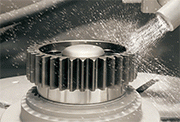
(!) L. G.: The main failure modes of gears are root fracture and surface pitting. Shot peening strengthens the surface through controlled impact, introducing residual compressive stress. This delays crack initiation and significantly improves fatigue life.
(?) MFN: As the automotive industry moves toward electrification and lightweight design, what insights has Peentech gained in automotive gear shot peening?
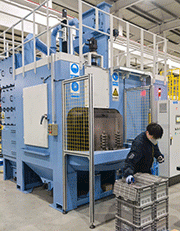
(!) L. G.: With the evolution of transmission systems, Peentech’s automotive gear shot peening has progressed through four stages of innovation, driven by increasing demands for load capacity, durability, and stricter NVH performance.
In the 1990s, manual transmissions dominated, and shot peening was newly introduced in China. Typical applications, such as the Shanghai Santana, used impeller-type blasting, achieving residual stress of around 800 MPa at 30–50 μm below the surface. This mainly addressed basic root fracture issues.
From 2010 to 2020, automatic transmissions, especially DCTs, became mainstream. Requirements increased significantly, with both root and surface fatigue performance needing improvement. Residual stress reached approximately 1000 MPa, and about half of all gears required shot peening. During this period, Peentech introduced second-generation equipment featuring automation and high productivity, though with relatively high investment and longer lead times.
Since 2020, the industry has entered the electrification era. Electric drive gears operate at 10,000–25,000 r/min, further raising technical requirements. The key challenge is balancing surface roughness with residual stress distribution, with stress levels reaching about 1100 MPa at 20 μm below the surface.
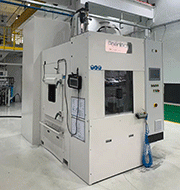
At the same time, customers increasingly demand flexibility. In response, we developed modular and compact equipment with shorter delivery times, around two months, and lower investment costs. Our N-GPT series has achieved strong market acceptance, with more than 100 units delivered.
We are currently developing a fourth-generation intelligent shot peening workstation, scheduled for launch on January 1, 2027. It will feature scalable peening units, AGV-based flexible automation, and the PEENMASTER Auto management system, combining efficiency with cost-effectiveness.
(?) MFN: As the wind power industry shifts toward high-power models, what technological breakthroughs and practical achievements has Peentech made in wind power gear shot peening?
(!) L. G.: Compared with automotive applications, wind power gear shot peening involves larger components, higher efficiency requirements, and stricter consistency control. As turbine capacities increase, Peentech’s wind power shot peening technologies have evolved through three major efficiency-driven upgrades.
In 2005, first-generation systems were introduced internationally, using trolley-type machines with manual handling and cycle times of around 40 minutes per gear.
In 2019, Peentech’s second-generation technology reduced processing time to 14 minutes per gear. By adopting wheel blasting, such as in the OH17/17 system, manual handling was eliminated, and automated single-machine operation was achieved.
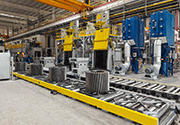
In 2021, Peentech’s third-generation systems further reduced cycle time to 8 minutes per gear. These systems use high-speed roller conveyor lines for continuous processing. Peentech also introduced the “strengthening furnace” concept, featuring independent blasting zones that allow different media and programmable processes, ensuring stable and repeatable results.
(?) MFN: What developments has Peentech achieved in shot peening for flexsplines used in harmonic reducers?
(!) L. G.: Flexspline shot peening presents challenges in miniaturization, precision, and ultra-long service life. As harmonic reducers expand from industrial robots to humanoid robotics, Peentech’s flexspline shot peening technology has undergone three stages of refinement.
In the 2010s, first-generation processes used 0.1–0.15 mm shot, primarily for deburring and cleaning.
From 2022, Peentech’s second-generation technology reduced shot size to 0.05–0.08 mm, significantly improving service life. Peentech’s 4RT150-WPC system has a compact footprint of just 4 m², a height of 3.3 m, and a delivery time of 1.5 months. More than 30 units have been delivered.
Peentech is now developing its third-generation technology, using ultra-fine 0.03 mm shot for humanoid robot joints. This introduces significant technical challenges, particularly in shot flow control and media recovery and separation.
(?) MFN: Based on Peentech’s practices, how do you see the current status and future trends of China’s gear shot peening industry?
(!) L. G.: China’s gear shot peening industry is entering a critical phase of high-quality development. Peentech’s experience shows that sustained R&D investment, a robust innovation system, and a focus on key processes can enable leadership in specialized technical fields.
From a follower to a technology leader, Peentech’s development journey reflects the broader progress of China’s high-end equipment manufacturing.
Looking ahead, shot peening will continue to grow as a core anti-fatigue process, with expanding applications and increasing importance in ensuring the reliability and longevity of advanced equipment.
(!) MFN: Special thanks to Leo Ge for this exclusive interview.
For Information:
Shanghai Peentech Equipment Tech.Co.,Ltd.
No. 5806, Huyi Road, Waigang Town,
Jiading District, Shanghai 201806, China
Tel. +86.021.59529798
E-mail: leo.ge@peentech.cn
www.peentech.cn




 BACK
BACK