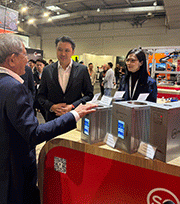
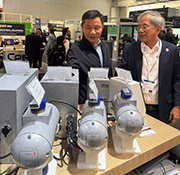
HANNOVER MESSE 2026, held from April 20 to April 24, 2026, in Hanover, Germany, once again demonstrated its status as one of the world’s most important industrial trade fairs. As a global platform for innovation and collaboration, the exhibition brought together thousands of companies, policymakers, and experts to explore the future of industry, technology, and global competitiveness.
The 2026 edition focused strongly on the transformation of industry through digitalization, automation, and sustainability. Despite a slightly lower number of exhibitors and visitors compared to previous years, the event remained highly influential, showcasing cutting-edge technologies and providing strategic direction for industrial development worldwide.
Core Themes and Technologies
The central theme of Hannover Messe 2026 was the integration of advanced technologies into industrial processes. Artificial intelligence (AI) emerged as the dominant topic, particularly in manufacturing and production environments. Exhibitors demonstrated how AI can optimize workflows, enable predictive maintenance, and improve overall efficiency.
In addition to AI, automation and robotics were major highlights. Visitors experienced autonomous robots, intelligent systems, and real-time, data-driven production technologies. These innovations illustrated how factories are becoming increasingly autonomous, flexible, and efficient.
Another key area was digitalization. Companies presented solutions that connect machines, systems, and data across entire value chains. This trend reflects the ongoing shift toward Industry 4.0, where digital technologies enable smarter and more responsive industrial ecosystems.
Energy technologies and sustainability also played an important role. Exhibits focused on energy efficiency, renewable energy integration, and sustainable industrial processes, highlighting the need for environmentally responsible production systems in the face of global climate challenges.
Surface Finishing
At the Hannover Messe, surface finishing was a key focus within advanced manufacturing. Companies showcased technologies such as coating, shot peening, polishing, and cleaning processes that improve the durability, corrosion resistance, and aesthetics of components. Exhibitors presented automated systems, environmentally friendly treatments, and digital monitoring solutions that enhance efficiency and quality control. The event highlights how surface engineering supports industries like automotive, aerospace, and machinery. Visitors gain insight into innovations that extend product life cycles and reduce maintenance costs, making surface finishing an essential part of modern industrial production and sustainable manufacturing strategies.
AI-Driven Industry and the "Factory of the Future"
One of the most striking aspects of the exhibition was the emphasis on AI-driven manufacturing. Companies such as NVIDIA and its partners demonstrated how advanced computing, simulation, and robotics are transforming industrial production.
These demonstrations showed that the “factory of the future” is no longer a theoretical concept but a reality in development. AI systems are now capable of designing products, optimizing processes, and even operating machines with minimal human intervention. This shift has significant implications for productivity, cost efficiency, and innovation.
Furthermore, the use of digital twins—virtual models of physical systems—enabled real-time monitoring and optimization of production processes. Combined with AI, these technologies allow companies to simulate scenarios, reduce risks, and improve decision-making.
New Focus Areas: Defense and Security Technologies
A notable new element in 2026 was the introduction of a dedicated focus on defense production technologies. For the first time, a specific exhibition area showcased innovations related to security and military manufacturing.
This addition reflects the changing geopolitical environment and the increasing importance of industrial capabilities in national security. Technologies presented in this area included advanced manufacturing systems, supply chain solutions, and production techniques designed for defense applications.
While this focus generated some debate, it also demonstrated how industrial innovation is closely linked to broader global challenges, including security and resilience.
Exhibitors, Visitors, and Economic Context
The 2026 edition hosted around 3,000 exhibitors and approximately 110,000 visitors. Although these numbers represent a decline compared to previous years, the event still attracted a highly international audience, with about 40% of visitors coming from abroad.
The decrease in attendance was partly attributed to travel disruptions, including strikes in transportation sectors. Despite this, the exhibition maintained its global relevance and continued to serve as a key meeting point for industry leaders.
The participating companies ranged from large multinational corporations to innovative startups. This diversity allowed for a dynamic exchange of ideas and highlighted the importance of collaboration between established industry players and emerging innovators.
Innovation, Startups, and Future Trends
Hannover Messe 2026 also placed strong emphasis on innovation and entrepreneurship. Startups played a significant role, presenting new technologies and business models that could shape the future of industry.
Key trends identified at the exhibition included:
• The increasing use of AI in all aspects of industrial production
• The integration of robotics into everyday manufacturing processes
• The importance of data-driven decision-making
• The growing role of sustainability and energy efficiency
These trends suggest that the future of industry will be characterized by greater automation, connectivity, and environmental responsibility.
Challenges and Outlook
Despite its success, Hannover Messe 2026 highlighted several challenges facing the industrial sector. These include economic uncertainty, geopolitical tensions, and the need for continuous innovation.
The exhibition demonstrated that companies are actively addressing these challenges by investing in advanced technologies and forming strategic partnerships. However, it also underscored the need for supportive policies, skilled labor, and international cooperation.
Looking ahead, the organizers announced that future editions of the fair will be slightly shorter, reflecting changes in visitor behavior and industry needs.
Conclusion
In conclusion, Hannover Messe 2026 provided a comprehensive overview of the current state and future direction of global industry. The exhibition highlighted the transformative impact of AI, automation, and digitalization, while also emphasizing sustainability and international collaboration.
Although attendance numbers declined slightly, the event remained a crucial platform for innovation, networking, and strategic discussion. It demonstrated that industry is not only adapting to global challenges but also actively shaping a competitive and sustainable future.
Overall, Hannover Messe 2026 confirmed its role as a leading global trade fair and a key driver of industrial transformation in the 21st century.
For Information:
Metal Finishing News (MFN)
Froihbergstrasse 38
8620 Wetzikon, Switzerland
Tel. +41.44.8312644
E-mail: info@mfn.li
MFN INTERNATIONAL: www.mfn.li
MFN CHINA: www.mfn.li/cn




 BACK
BACK