Because of the addition of water and liquid compound, mass finishing is generally known as a “wet” surface treatment technology. Water supports the finishing process and keeps it stable by removing contaminants from the process, such as media/metal fines and oil. At the same time, water serves as a coolant for the entire operation. Compounds remove stains, dirt, grease, and oil from the workpieces, keep the processing media clean, protect the finished workpieces against corrosion, and are used for brightening/burnishing the workpieces. The downside of “wet” finishing is that it requires a process water cleaning system as well as a drying system for the finished workpieces. Both can be quite expensive. Special dry mass finishing processes have been employed for decades without requiring any water or liquid compounds. Best known is the surface refinement of wood components, but particularly the polishing of metal components, such as orthopedic implants like artificial knee and hip joints. Lately, dry mass finishing methods are increasingly being utilized for deburring, edge radiusing, or surface smoothing of metallic components. In this article, we are looking at how dry mass finishing works, what benefits it offers, and what the limitations of dry finishing are.
How does it work, and what are the benefits of dry mass finishing?
Basically, dry and wet finishing processes employ the same functional principle: A mix of grinding or polishing media and unfinished workpieces is exposed to mechanical motion. This can be simple rotation, vibratory or centrifugal force, as well as dragging the workpieces through a bed of stationary (drag finishing) or rotating media (surf finishing). In the case of wet finishing, water and chemical compounds are continuously added to support the process and keep it stable. In dry mass finishing operations, no water or compound needs to be added.
Benefits
• In wet finishing operations, the water added to the process causes very thin, flat workpieces to stick together. This may affect the finishing results and require special additives to separate the stuck workpieces. No such problems occur with dry finishing operations.
• Contrary to wet operations, dry finishing processes do not require drying of the finished workpieces.
• Since, in dry processes, the workpieces are not exposed to water, there is no risk of oxidation or corrosion. Therefore, no extra corrosion protection measures are needed.
• Last but not least, since no water or liquid compounds are added in dry finishing operations, they do not require expensive wastewater treatment equipment.
Considering that drying and water treatment systems alone can amount to 15–20% of the total costs of a wet mass finishing system, these benefits represent substantial cost-saving potential.
The key elements of dry mass finishing
Dry mass finishing processes run in the same machines as wet finishing operations and do not need any water or compound dosing systems. However, since dry processes produce dust, the machines must be equipped with dust extraction vents and a fresh air inlet. The exhaust air, contaminated with dust, may have to be cleaned in a separate dust collector.
Generally, in low-energy systems like rotary barrels and vibratory machines, heat is no issue. Operating temperatures usually do not exceed 30–40°C. However, in high-energy systems, such as centrifugal equipment as well as drag and surf finishers, heat generation can pose a problem. Such high-energy machines must be equipped with special cooling systems.
Typical dry finishing machines
Rotary barrels
Depending on their size, rotary barrels can handle workpieces with lengths of over 6,000 mm.
Rotary and tub vibrators
Vibratory machines can handle workpieces ranging from a few centimeters up to lengths of over 6,000 mm. They usually have a dust extraction vent at the bottom of the processing bowl. In addition, they are equipped with a fresh air inlet in the form of a cover on top of the vibrator.
Centrifugal disk finishing machines
These high-energy systems are used for dry polishing as well as deburring/edge radiusing and surface grinding. Fresh air is injected through the gap between the rotating spinner and the processing bowl. The air, contaminated with dust, is extracted from the top of the machine. Certain dry finishing operations may require a cooling system to protect the machine against heat damage.
Drag finishing/surf finishing systems
These machines are very effective for dry polishing operations, usually with corn cob pellets or crushed walnut shells. Dry deburring/surface grinding is theoretically possible but technically difficult to implement.
The processing media for dry finishing
Polishing: Typical dry polishing media are corn cob pellets or crushed walnut shells mixed with a special polishing paste.
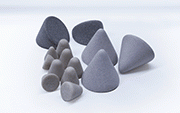
Deburring/edge radiusing/surface grinding: Special "open-structure" plastic media, typically filled with abrasives such as quartz or zirconium.
For pressure deburring: Specially shaped metallic media made from aluminum or steel.
The shortcomings of dry mass finishing
Like any other surface refinement technology, dry finishing offers significant benefits to the user. But it also has its shortcomings:
Workpiece shape
Dry finishing applications are limited to components with simple geometries. They cannot contain any areas that are difficult to reach, such as undercuts, drilled holes, or internal surface areas.
Oily workpieces
The workpieces must not be covered with oil. Too much oil carried into the finishing machine would quickly ruin the entire process. Small residual amounts of oil can be handled by mixing oil-absorbing granules into the processing media. But even this is only a stop-gap measure and not a long-term solution. The fact is that oil and dry finishing are not compatible with each other!
Dust issues
Dry finishing generates dust, which must be quickly extracted to keep the process stable. Since the generated dust is hazardous, it cannot simply be discharged into the atmosphere but must be handled with an enclosed dust collection system. With some workpiece materials, for example magnesium and aluminum, the dust can also be flammable. In such cases, the dust collection system must be protected against combustion and explosions.
Even with suitable dust extraction systems, some residual dust can settle on the finished workpieces. Therefore, the finished workpieces may have to undergo a cleaning operation using a blow-off system or a rinsing unit.
Processing times
Compared to wet processes, dry finishing generates a lower material removal rate. Therefore, users must expect longer cycle times, resulting in higher amortization costs for the finishing equipment.
Typical dry finishing applications
Dry finishing is ideal for polishing operations where the workpieces must have a mirror finish. Best known for high-quality dry finishing is the polishing of orthopedic implants like artificial knee and hip joints before they are implanted into the body. For certain workpiece types and materials, it can also be quite effective for deburring/edge radiusing, surface grinding, and smoothing.
Wood
Dry processes are equally effective on hard and soft wood materials as well as plywood. They are used to place the finishing touch on wooden toys, decorative wood components, and all kinds of wooden accessories.
Metallic components
All kinds of metals, such as zinc, aluminum, brass, steel, and stainless steel, are suitable for dry finishing operations. However, the workpieces must have a simple shape and must not contain any difficult-to-reach areas like undercuts, drilled holes, or internal surfaces.
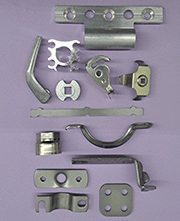
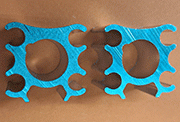
Typical workpieces are zinc buckles for shoes, belts, and handbags. Aluminum components can include fittings, handles, housings, milled profiles, and aluminum sheets. Workpieces made from brass can include housings and fittings. Dry finishing is equally effective on steel/stainless steel components such as laser-, plasma-, and flame-cut parts and stampings.
The future of dry finishing?
The fact that it requires no drying operation and no wastewater treatment equipment makes dry finishing economically very attractive. However, some of the cost benefits are offset by expenses for dust extraction and dust collection. Dry finishing becomes economically less feasible when high-energy finishing systems are used, which may require the installation of a cooling system.
Users will also have to consider that, compared to wet finishing operations, dry processes are less effective with regard to material removal from the workpieces and, therefore, require longer cycle times.
Finally, dry finishing is somewhat limited to workpieces with simple shapes. It does not represent a solution for workpieces with complex geometries.
After considering all the pros and cons, one can conclude that dry finishing is an interesting alternative to wet mass finishing operations. However, because of its limitations with regard to workpiece shape, longer cycle times, the need for dust extraction and collection equipment, and possibly the requirement for cooling equipment, dry finishing will remain a niche technology with somewhat limited applications. Nevertheless, whenever a user has to install a new surface finishing system, dry finishing deserves careful consideration.
Good Vibrations
by Eugen Holzknecht
Contributing Editor MFN and
Rösler Oberflächentechnik GmbH
E-mail: holzknecht.usa@gmail.com




 BACK
BACK