
E-Archive
 BACK
BACK
Articles
in Vol. 27 - July Issue - Year 2026
Macro-finishing at Room Temperature
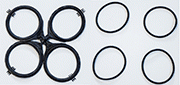
Before – After: The new macrofinishing machine MF-15L from C.S.I. Centro Servizi Industriali automatically removes runner and overflow flashing from injection moulded elastomer parts

The feeder belt conveys the raw moulded parts into the processing container

The storage container of the system has a capacity of 200 liters

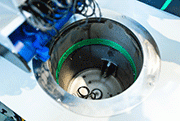
The raw parts are batchwise filled into the container

Before – After: Cable feedthroughs before (left) and after (right) processing
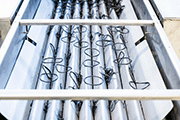

In the three-stage separation section, O-rings and other moulded parts are separated from gating and overflow material
C.S.I. Centro Servizi Industriali was founded in 2021 by Stefano Ferrari and Danilo Olivini. Marcello Plebani and Dieter Adamkiewicz, also experts in the field of rubber and plastics technology, joined the company in 2023. C.S.I. provides a broad range of services for customers in the rubber and plastics industry, from surface treatments and finishing services to the performance of special laboratory analyses. The company’s comprehensive range of surface-coating equipment includes a plasma plant for pretreatment processes as well as five Rotamat coaters and one parylene coating system for O-rings and other moulded parts. C.S.I.’s laboratory equipment includes systems for residual dirt analysis, FTIR spectroscopy, and coating thickness measurements. C.S.I. represents the German companies Walther Trowal in the field of surface finishing systems and Zeiss in the field of measuring systems for elastomer analysis. C.S.I.’s facilities at the location in Bolgare in the Italian province of Bergamo are operated by ten employees. In addition to finishing services, the company also provides maintenance services for equipment of AW Maschinen- & Anlagentechnik GmbH.
The new macrofinishing machine MF-15L from C.S.I. Centro Servizi Industriali removes runner and overflow flashing from injection moulded elastomer parts in an automated process that does not require any prior cooling of the parts in liquid nitrogen. This process reduces energy consumption, thus making a significant contribution to the protection of the environment and cutting production costs.